
A slat wall behind the TV can be a weekend glue-and-screw panel job or a curved partition that needs an electrician and a steel foot plate.
The deciding factor is whether you own the wall or merely inhabit it: renters stick to adhesive and flat panels, first-home owners can bolt through backing and add a fireplace.
The proof is in the hardware lag bolts pass straight through acoustic felt into studs for a direct mount, but need a plywood backer or longer bolts when slats sit on furring strips.
[link-whisper-related-posts]1. TV Mounted Directly on Slat Panels
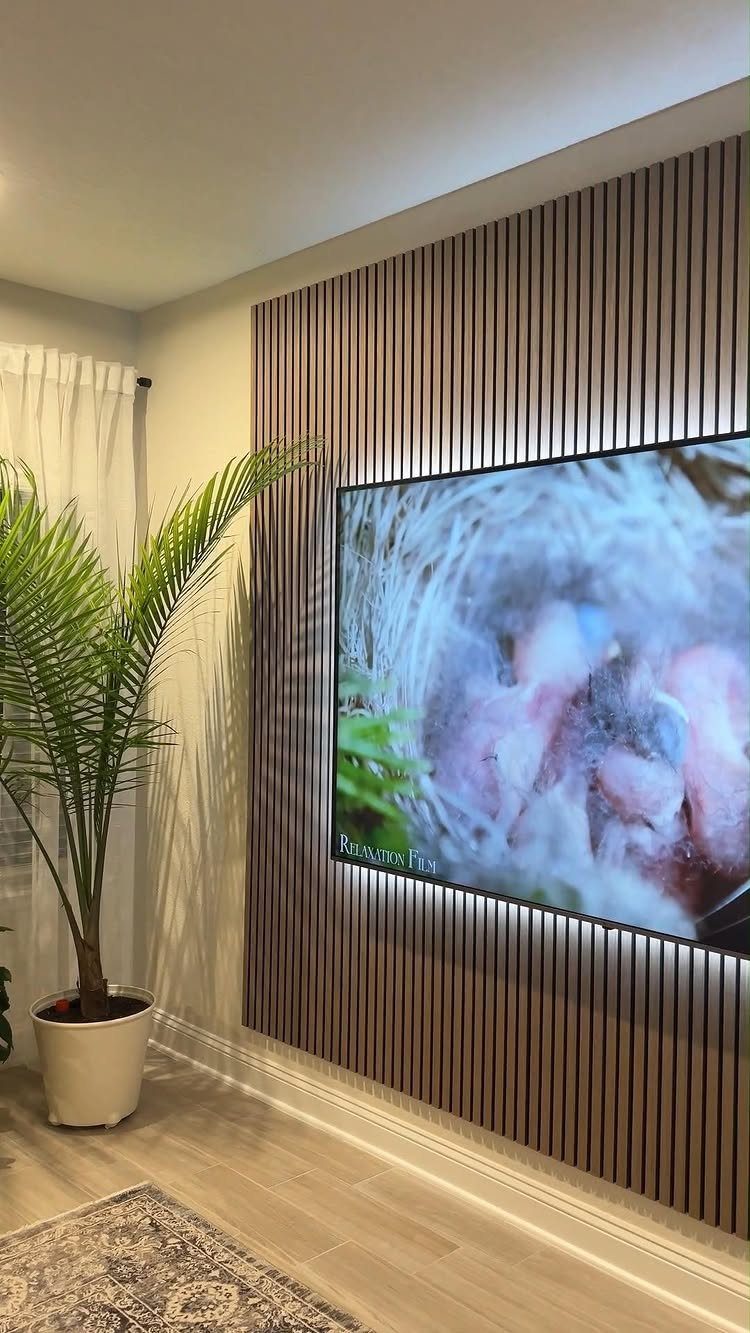
Mounting a TV straight onto slat panels means finding the studs first, then running long lag bolts through the slats and felt into solid framing behind.
Panels mounted flat to the wall let hardware pass straight through; slats on furring strips call for longer bolts or a plywood backer behind them.
Acoustic felt backing helps dialogue sound clearer by absorbing the high frequencies that bounce off drywall and muddy speech. I’d do this for any living room where the TV sees daily use and the budget is tight.
The shadow lines frame the screen without adding clutter.

MODERN DESIGN, REAL ACOUSTICS: Japandi-style wood slat panels add natural warmth and 3D texture to your walls, while the felt backing absorbs sound to reduce echo — ideal for living rooms, bedrooms, and home offices.

[TESTED NRC 0.80—REDUCE ECHO & REVERBERATION] Hard walls, ceilings and floors reflect conversations, TV audio, music and gaming sound, often creating distracting echo. With a tested NRC rating of up to 0.80, these wood slat acoustic panels absorb reflected sound for clearer, more comfortable room acoustics. Designed to improve sound quality within a room—not to completely block sound transmission through walls.

FULLY DIY NO-STUD PATENTED SOLUTION: HangSmart TV offers a complete DIY no-stud mount experience, making it a perfect choice for homeowners and renters who prefer a no-fuss, easy-to-handle installation process for their flat screen TVs
2. Wood Slat Wall Behind TV
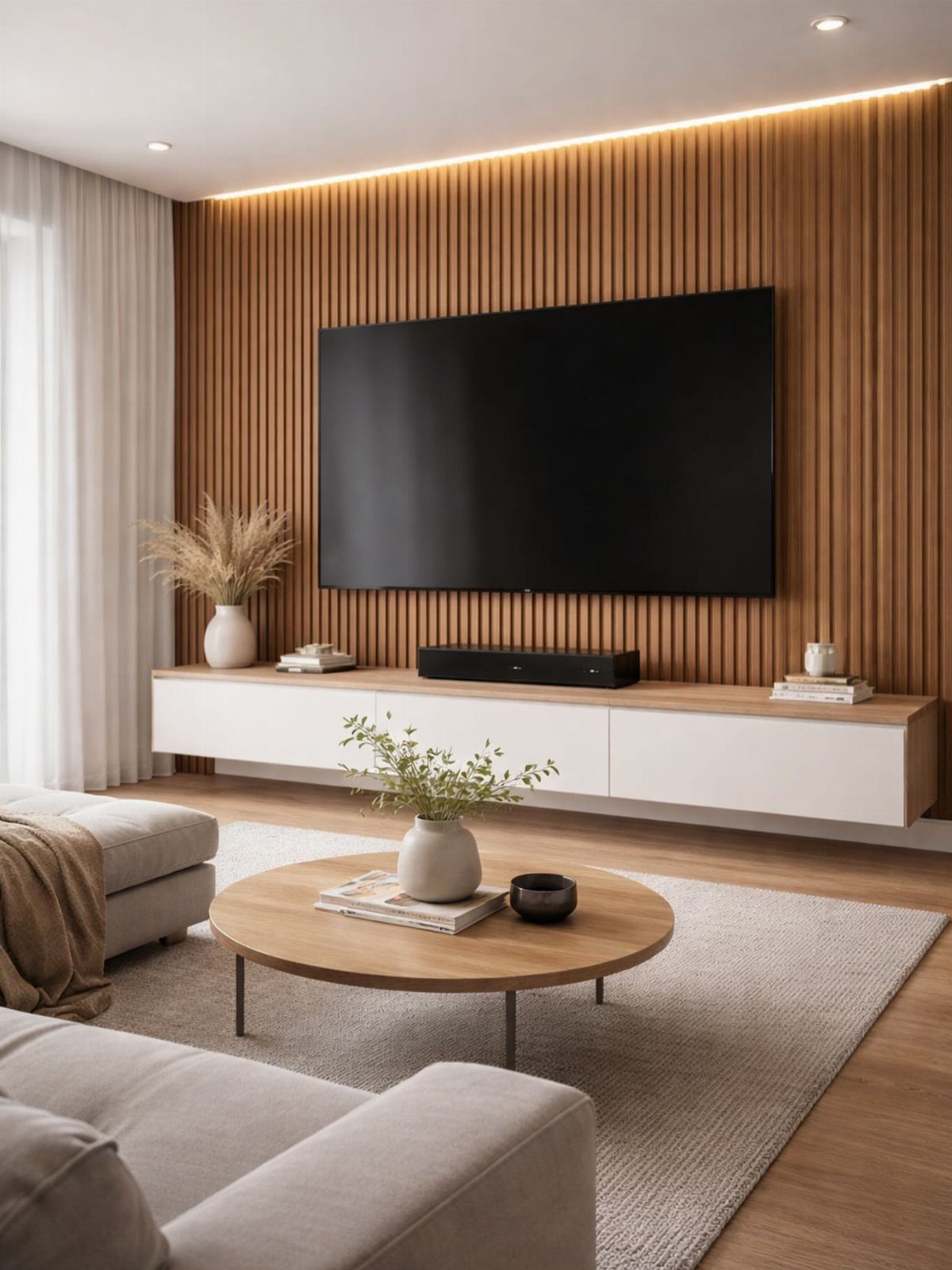
A full wood slat wall behind the TV softens sound reflections that make action scenes sound harsh and voices hard to follow.
Natural oak reads warm in rooms with daylight; smoked oak or black oak suit darker spaces where you want the screen to disappear when it’s off.
The acoustic backing on panels from manufacturers like Aku Wood Panel handles mid-to-high frequency absorption, so you skip a separate acoustic treatment.
For a rental or first home, this is a strong weekend project: panels screw or glue to the wall, and a 3-panel run covers most standard TV walls. Walnut costs more but gives high-contrast punch if your furniture runs light.

EFFECTIVE SOUND ABSORPTION: These acoustic wall panels help reduce echo and soften reverb for clearer calls, gaming, music, and TV sound, giving home offices, studios, bedrooms, and living rooms a calmer feel than basic foam acoustic panels

Cover More Walls with Fewer Panels: This 6-pack wood panels for wall set covers approximately 46.5 sq ft with six oversized panels, making it easier to complete feature walls, media walls and larger interior projects with fewer seams and a cleaner finished appearance
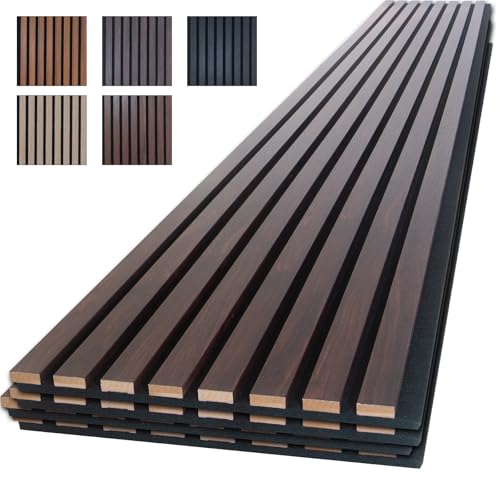
Modern and Elegant Design - The wood slat wall panels have been carefully designed to effortlessly transform any space, enhancing the surroundings both visually and acoustically. The wood panels help to create an environment that is not only quiet but beautifully contemporary, soothing and relaxing. Furthermore, our slat wall panels can be installed horizontally or vertically and cut to any shape allowing for creativity and a unique look to fit your aesthetics.
3. Strip Lighting on Slat Wall
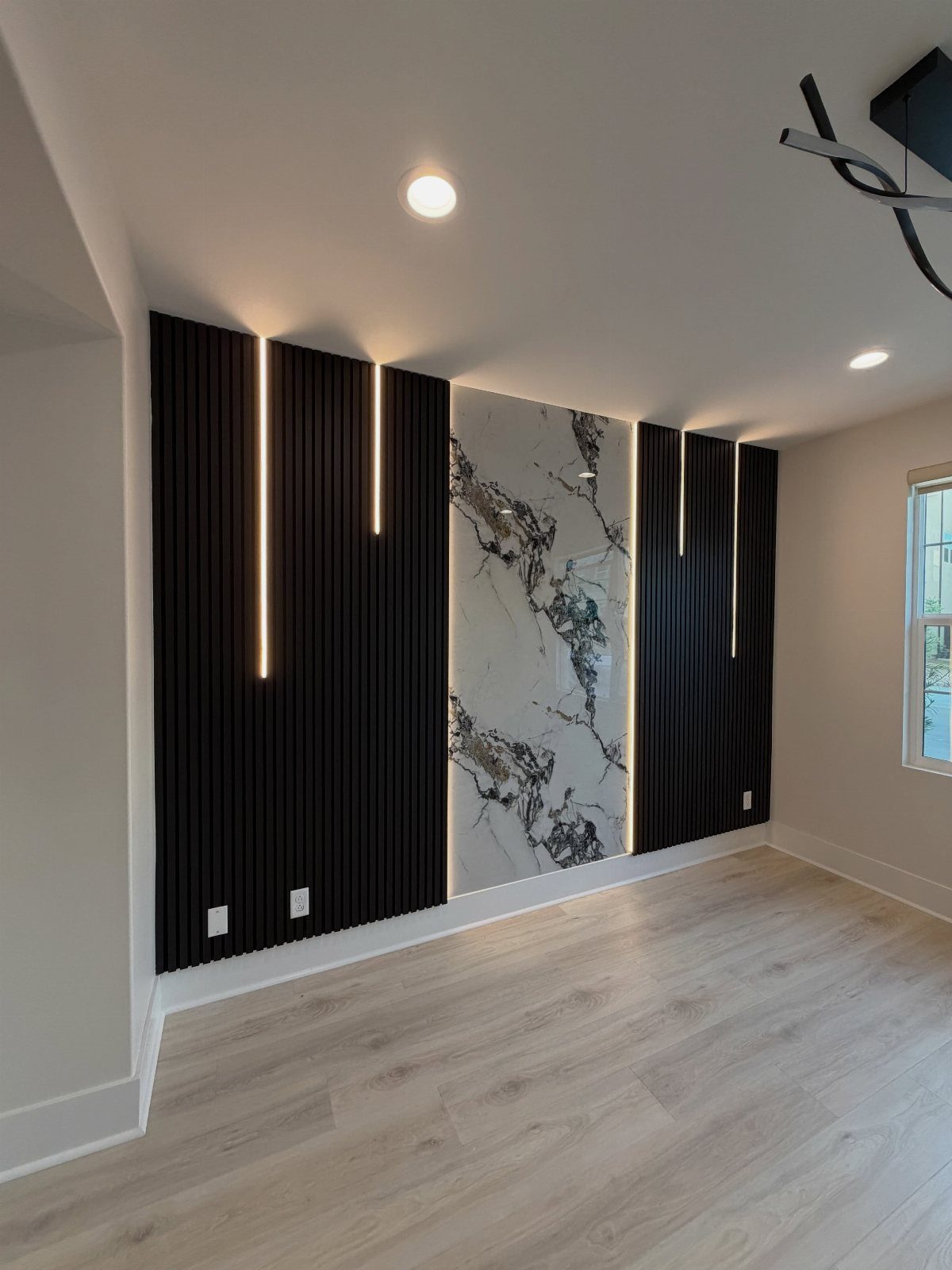
Vertical LED strips set into the slats turn the wall into a dimmable frame for the screen.
Warm lines flanking a marble center come from shallow channels routed into the slat edges, or you can buy panels with light tracks already built in.
Measure your ceiling height, then cut panels to fit with 10 mm to spare for the strip housing at top and bottom. A circular saw and work table handle the cuts clean.
I’d wire this to a smart dimmer so movie night doesn’t mean hunting for a switch behind the sofa. The linear light draws the eye to the wall even when the TV is off.

Black LED Linear Lighting Kit: The LED light strips measure 4" x 4" and are available in various lengths, including 10 inches, 16 inches, 20 inches, 24 inches, 30 inches, 36 inches, and 40 inches. Each configuration can accommodate 6 to 8 parallel LED wall panel lights, allowing for customized layouts in any space.

Seamless Integration---Expertly engineered for slat wall panels, this flexible light strips features a low-profile 0.51" x 0.39" design that disappears seamlessly between slats. It emits 3000K warm white glow that highlights your wall's texture beautifully. The matte black silicone housing ensures discreet recessed lighting that complements wood panels, creating luxurious ambient lighting.
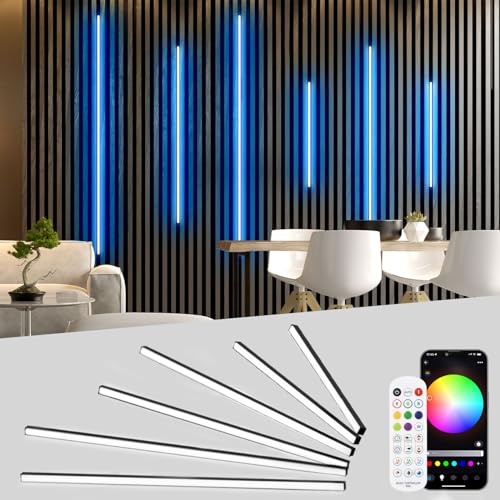
6 Pcs RGB Black led recessed lights for acoustic panel: The black acoustic panel LED Strip measures 0.394 * 0.394 in and is available in various lengths, including 16 in, 24 in, and 36 in. Each configuration accommodates six parallel led panel lights. The LED strip's input cable is 2 M/6.56FT , allowing for more flexible wiring options. The black smart recessed lighting is particularly suitable for acoustic panels, slat wall panel, wooden acoustic panels, cabinet and shelf lighting
4. Black Oak Finish
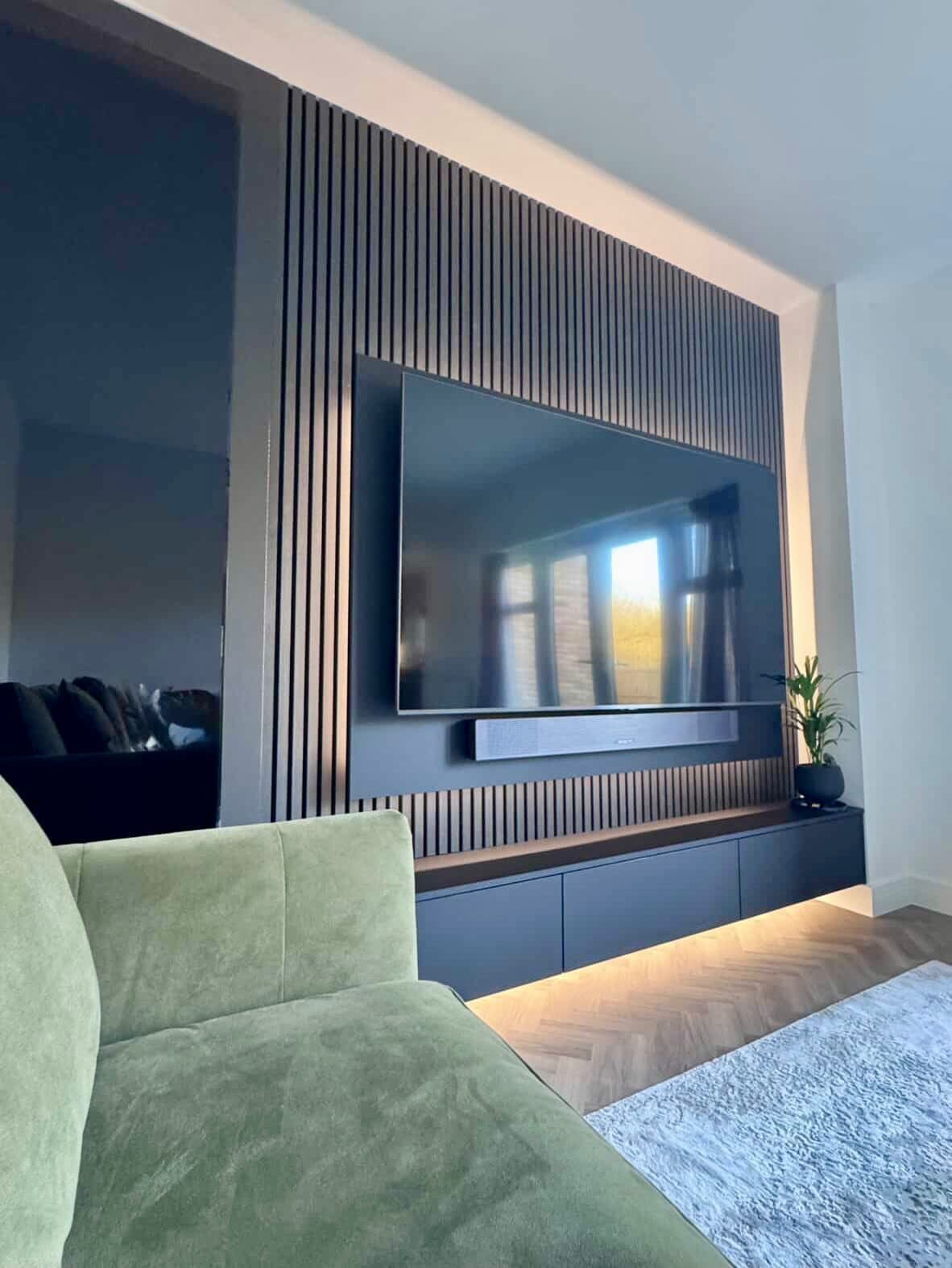
Black oak slats make the screen vanish when it’s powered down, which is why home theater builders reach for it first.
The risk is real: in a bright room with south-facing windows, the wall can feel like a cave unless you balance it with light floors, pale furniture, or a light-colored rug.
It works beautifully in a basement media room with a green sofa and herringbone oak floors. For a multi-purpose living room that sees morning coffee and afternoon sun, natural or smoked oak forgives more.
The black finish demands intentional lighting; add none and the wall swallows the space.
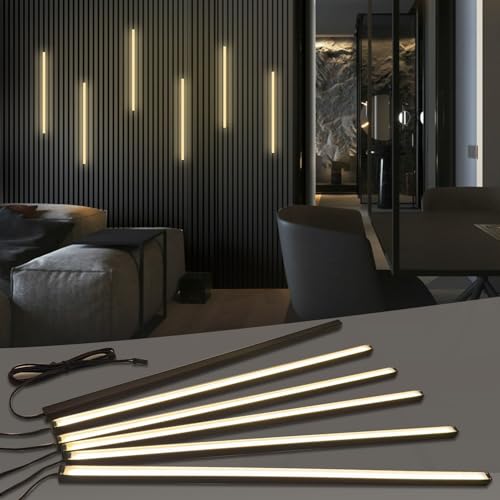
𝐅𝐮𝐬𝐞𝐝 𝐁𝐥𝐚𝐜𝐤 𝐂𝐨𝐥𝐥𝐞𝐜𝐭𝐢𝐨𝐧: This wall panel lights set Includes 6-piece of 16-inch 12V black LED strip lights. These slat wall lights feature black aluminum profiles, matte black diffuser covers and 3.1m black extension cables for flexible wiring. The 𝟎.𝟒-𝐢𝐧𝐜𝐡 𝐰𝐢𝐝𝐞 all-black wall panel LED lights seamlessly blends into slat panel gaps, easy to conceal and ideal for decorative black, matte black, gray oak, teak and black walnut wood slat wall panels etc. (𝐍𝐨𝐭𝐞: 𝐈𝐏𝟑𝟎 𝐍𝐨𝐭 𝐖𝐚𝐭𝐞𝐫𝐩𝐫𝐨𝐨𝐟 𝐖𝐢𝐫𝐞𝐝 𝐋𝐢𝐠𝐡𝐭 𝐒𝐭𝐫𝐢𝐩 𝐡𝐞𝐢𝐠𝐡𝐭: 𝟎.𝟒". 𝐏𝐚𝐧𝐞𝐥 𝐭𝐡𝐢𝐜𝐤𝐧𝐞𝐬𝐬 ≥𝟎.𝟒𝟑" 𝐢𝐬 𝐫𝐞𝐪𝐮𝐢𝐫𝐞𝐝 𝐟𝐨𝐫 𝐟𝐥𝐮𝐬𝐡 𝐢𝐧𝐬𝐭𝐚𝐥𝐥𝐚𝐭𝐢𝐨𝐧.)

𝑪𝒖𝒔𝒕𝒐𝒎 5𝑪𝑪𝑻 𝑪𝒐𝒎𝒇𝒐𝒓𝒕 𝑳𝒊𝒈𝒉𝒕𝒊𝒏𝒈: These slat wall lights offer 2700K, 3000K, 3500K, 4000K and 5000K to match real daily living—from cozy bedroom evenings to bright office focus lighting. One fixture adapts to every season, mood, and room style while reducing the guesswork of choosing the wrong light color. 𝐍𝐨𝐭𝐞: 𝐀𝐥𝐥 𝟔 𝐥𝐢𝐠𝐡𝐭 𝐛𝐚𝐫𝐬 𝐚𝐥𝐰𝐚𝐲𝐬 𝐝𝐢𝐬𝐩𝐥𝐚𝐲 𝐭𝐡𝐞 𝐬𝐚𝐦𝐞 𝐜𝐨𝐥𝐨𝐫 𝐭𝐞𝐦𝐩𝐞𝐫𝐚𝐭𝐮𝐫𝐞. 𝐖𝐡𝐞𝐧 𝐬𝐰𝐢𝐭𝐜𝐡𝐢𝐧𝐠 𝐂𝐂𝐓 𝐦𝐨𝐝𝐞𝐬, 𝐚𝐥𝐥 𝐥𝐢𝐠𝐡𝐭 𝐛𝐚𝐫𝐬 𝐜𝐡𝐚𝐧𝐠𝐞 𝐬𝐢𝐦𝐮𝐥𝐭𝐚𝐧𝐞𝐨𝐮𝐬𝐥𝐲 𝐭𝐨 𝐭𝐡𝐞 𝐬𝐞𝐥𝐞𝐜𝐭𝐞𝐝 𝐜𝐨𝐥𝐨𝐫 𝐭𝐞𝐦𝐩𝐞𝐫𝐚𝐭𝐮𝐫𝐞

Perfect Fit for GZBtech Grid Lights--These clips are specifically designed to work with GZBtech brand wood slat wall panels strip lights. It perfectly matches the light strip dimensions of 0.51'' x 0.31' for a secure and reliable hold.
5. Flanking Slat Panels with Fireplace
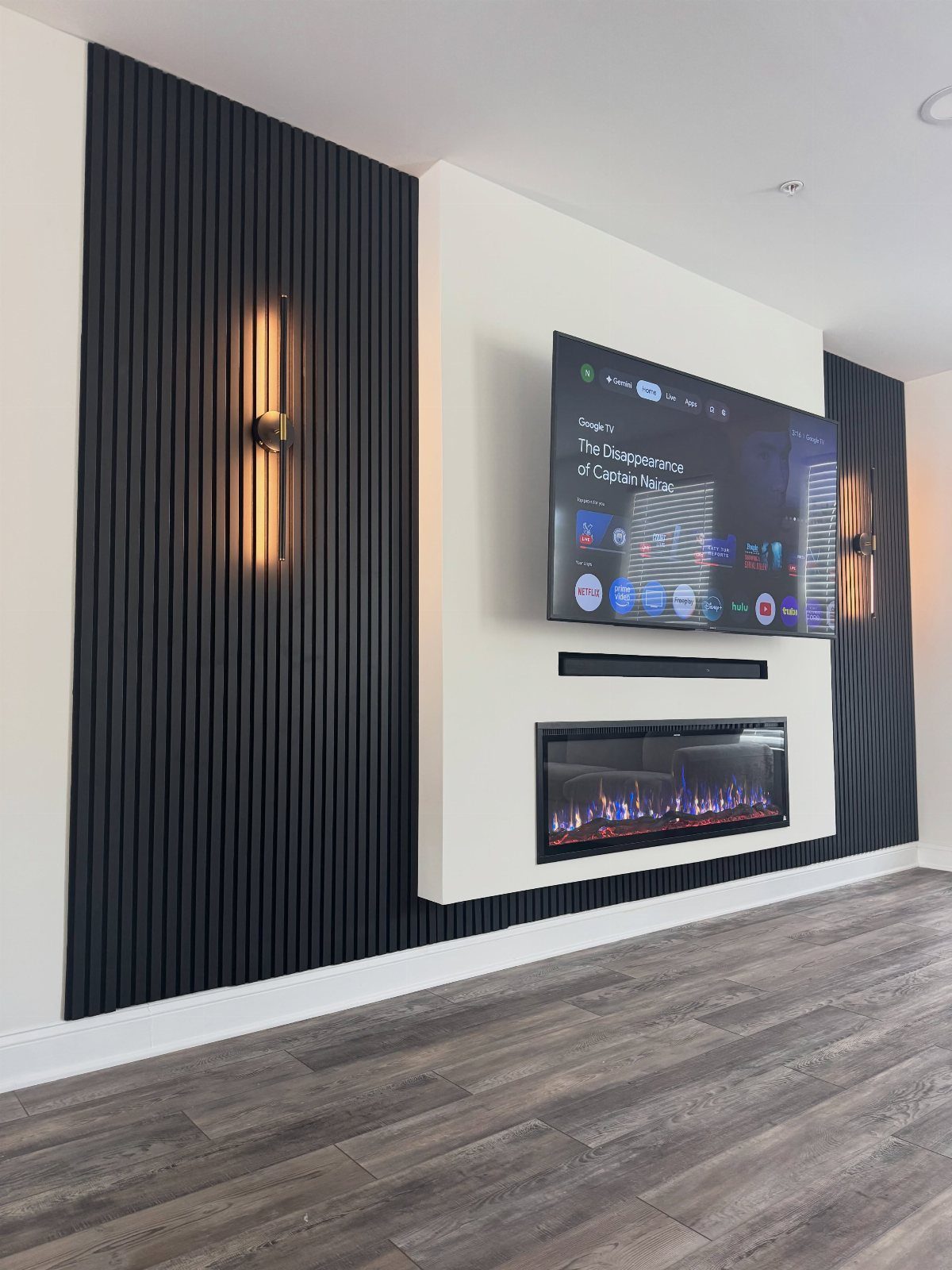
Black slat panels on both sides of a recessed white center create a frame that holds both the TV and an electric fireplace without crowding either.
The white bump-out sets forward from the slats, so the screen and fire sit at one plane while the textured panels fall back.
Screws through the felt backing at top and bottom anchor each panel; grab adhesive works too if you can’t locate studs precisely. I’d keep the recess deep enough to hide cable runs and any fireplace venting.
This suits open-plan rooms where the TV wall faces the kitchen or dining area and needs to read as architecture, not an afterthought.

Easy Peel & Stick Installation--Features a strong self-adhesive backing for quick and mess-free application. Just peel and stick to transform your space instantly.

Modern and Elegant Design - The wood slat wall panels have been carefully designed to effortlessly transform any space, enhancing the surroundings both visually and acoustically. The wood panels help to create an environment that is not only quiet but beautifully contemporary, soothing and relaxing. Furthermore, our slat wall panels can be installed horizontally or vertically and cut to any shape allowing for creativity and a unique look to fit your aesthetics.

Modern and Elegant Design - Yuzzy wood slat wall panel brings an elegant architectural detail to your room. You've seen it in high-end homes and hotels, where a wall with vertical strips of wood plays with light and shadow, giving a room an organic vibe, while reducing echo and improving your acoustics.
6. Marble Center Panel with Slats
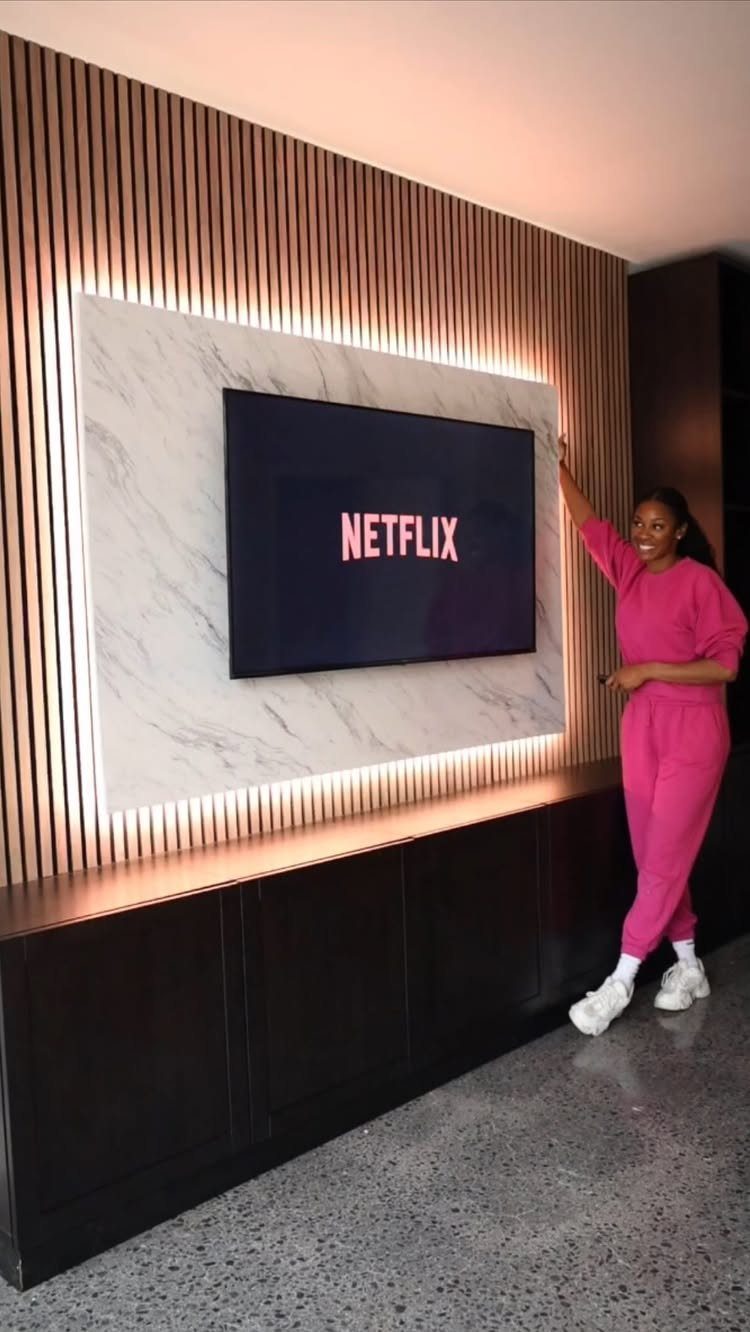
Layering a smooth marble panel over the slat wall gives the TV a solid landing pad while the slats keep their acoustic work behind it.
White marble with warm backlighting between the two surfaces needs a gap, which you build with painted wood spacers or aluminum standoffs. Mount the TV bracket to the marble, not the slats, so the weight bears on something continuous.
Black base cabinets below, like the ones here, ground the whole composition. I’d pick a honed marble over polished; it hides dust and finger smudges from cable adjustments behind the screen.
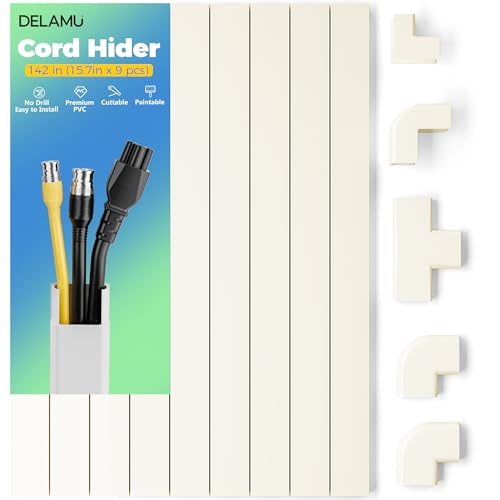
Passing the UL94 V-0 Rating Test: A plastics flammability standard released by Underwriters Laboratories of the United States, UL94 V-0 Rating is defined as Burning stops within 10 seconds on a vertical part allowing for drops of plastic that are not inflames, which means it's safer than ordinary materials because of the higher flame retardancy and brings greater security to your daily use

This dry wall mount TV bracket is universally designed to fit most screens 42" to 90" and up to 135bs from top brands like Samsung, LG, TCL, Sony and more.

THICKER 21MM PANELS — Our MDF slats are 12 mm thick, giving each panel a stronger build and a deeper 3D look. Together with the 9 mm felt backing, the panel is 21 mm thick in total. The thicker slats stand out more from the wall, making the wood grain and shadow lines easier to see.
7. Curved Slat Wall
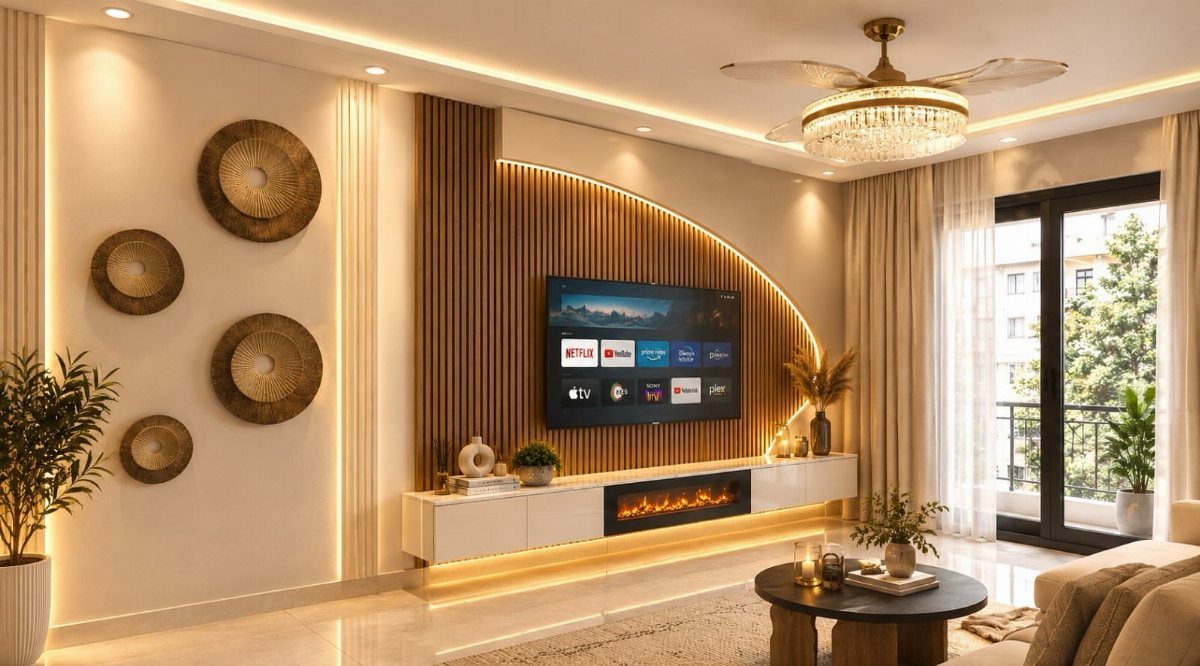
Curving a slat wall softens a room’s geometry without losing the acoustic benefit of the gaps. A generous radius keeps the slats from kinking at the edges.
That scale needs a plywood or MDF backer cut to shape first; the slats get glued and pin-nailed to follow the curve.
LED strip lighting tucked behind the top edge grazes downward and picks out each gap, but the glow depends on a consistent reveal, so shimming uneven walls matters more here than on a flat install.
I’d only attempt this if the TV mount has a full-motion arm. A fixed bracket on a curved surface leaves the screen tilted wrong and no way to correct it.
The slim electric fireplace below pairs well because neither element competes for floor space. Two trades in one weekend: doable if the electrical is already roughed in, otherwise call an electrician first.

Modern and Elegant Design - The wood slat wall panels have been carefully designed to effortlessly transform any space, enhancing the surroundings both visually and acoustically. The wood panels help to create an environment that is not only quiet but beautifully contemporary, soothing and relaxing. Furthermore, our slat wall panels can be installed horizontally or vertically and cut to any shape allowing for creativity and a unique look to fit your aesthetics.

Modern and Elegant Design - The wood slat wall panels have been carefully designed to effortlessly transform any space, enhancing the surroundings both visually and acoustically. The wood panels help to create an environment that is not only quiet but beautifully contemporary, soothing and relaxing. Furthermore, our slat wall panels can be installed horizontally or vertically and cut to any shape allowing for creativity and a unique look to fit your aesthetics.

EFFECTIVE SOUND ABSORPTION: These acoustic wall panels help reduce echo and soften reverb for clearer calls, gaming, music, and TV sound, giving home offices, studios, bedrooms, and living rooms a calmer feel than basic foam acoustic panels
8. Partial Slat Accent Panel
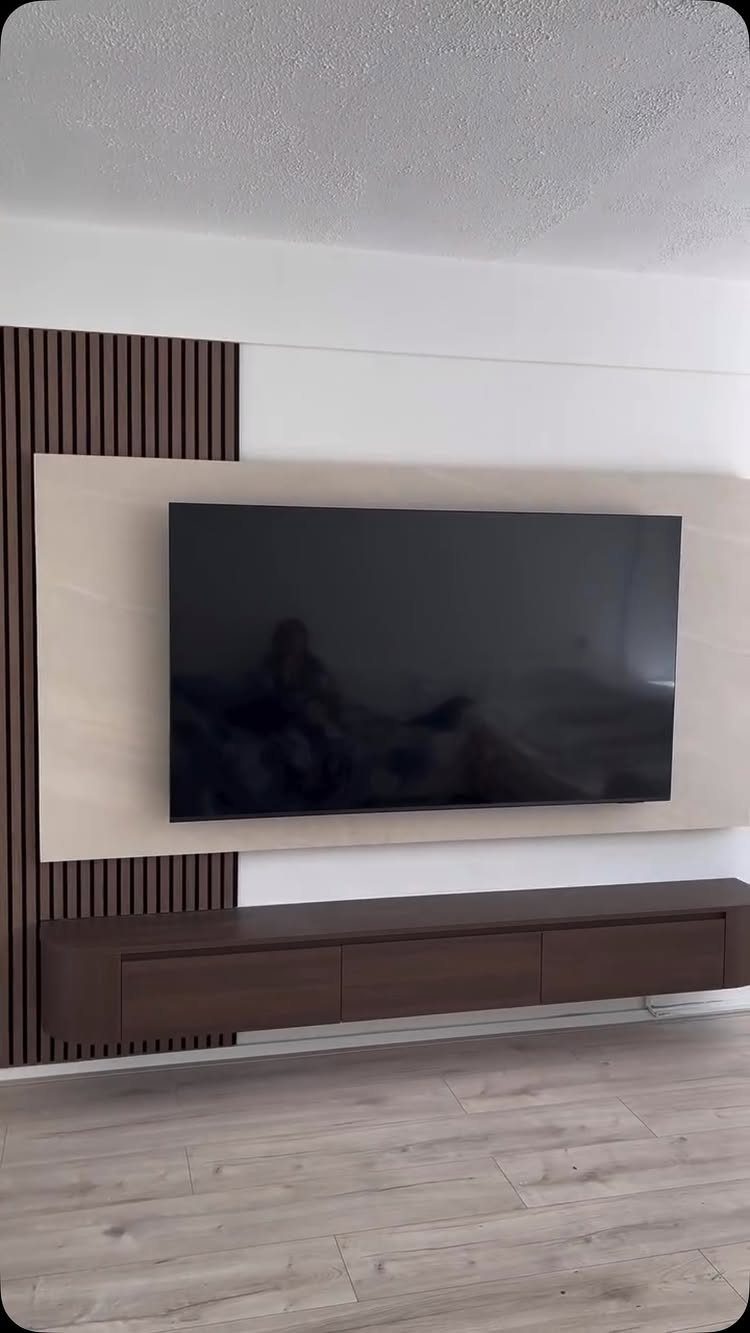
Stopping slats partway across a wall saves material and draws the eye to the TV as a deliberate object rather than a black rectangle in a sea of texture.
The panel reads as a solid anchor; the slats to its left add rhythm without wrapping the whole room. Measure for the full rectangle first, then decide where the slat field ends.
Order 10% extra paneling for cuts at the boundary, and ask the supplier for end-cap pieces rather than leaving a raw slat edge against the paint.
That cleaner termination costs a little more per linear foot but reads intentional from across the room.
Adhesive works for the slat section if the wall is flat, but the solid panel needs mechanical fastening at stud locations; the TV’s weight hangs from that, not the decorative layer.
Check for outlets before you cut, and mark their locations on the back of each panel before lifting it. These panels run heavy, so a second pair of hands is not optional.

Perfect Fit for Wood Slat Wall & Acoustic Panel Recessed Lighting: Specially designed for narrow grooves in wood slat walls, acoustic panels and LED wall panels, this silicone strip light creates a seamless, flush wall panel light effect. Its low-profile body fits snugly into standard recessed lighting channels, avoiding the bulky protruding look of regular light strips.

SMART RGB+IC BLACK LED LIGHTS FOR ACOUSTIC PANELS - Our led lights for wood slat wall panels are featured in three versatile sizes for flexible configuration: 15in*22in*35in; 22in*35in*54inch; 54inch*54inch*54inch. Each size comes with 6 packs. Offering you to create custom configurations for different spaces such as wood slat wall panels, Headboards, Stairs, Under Cabinet, home decor

NOISE CONTROL SOLUTION: If you're looking to reduce noise and eliminate reverberations in a variety of environments such as offices, meeting spaces, or living areas, these wall panels offer an effective solution. Enhance your acoustic environment with these panels, fostering a more serene and focused ambiance.
9. White Panel Against Dark Slats
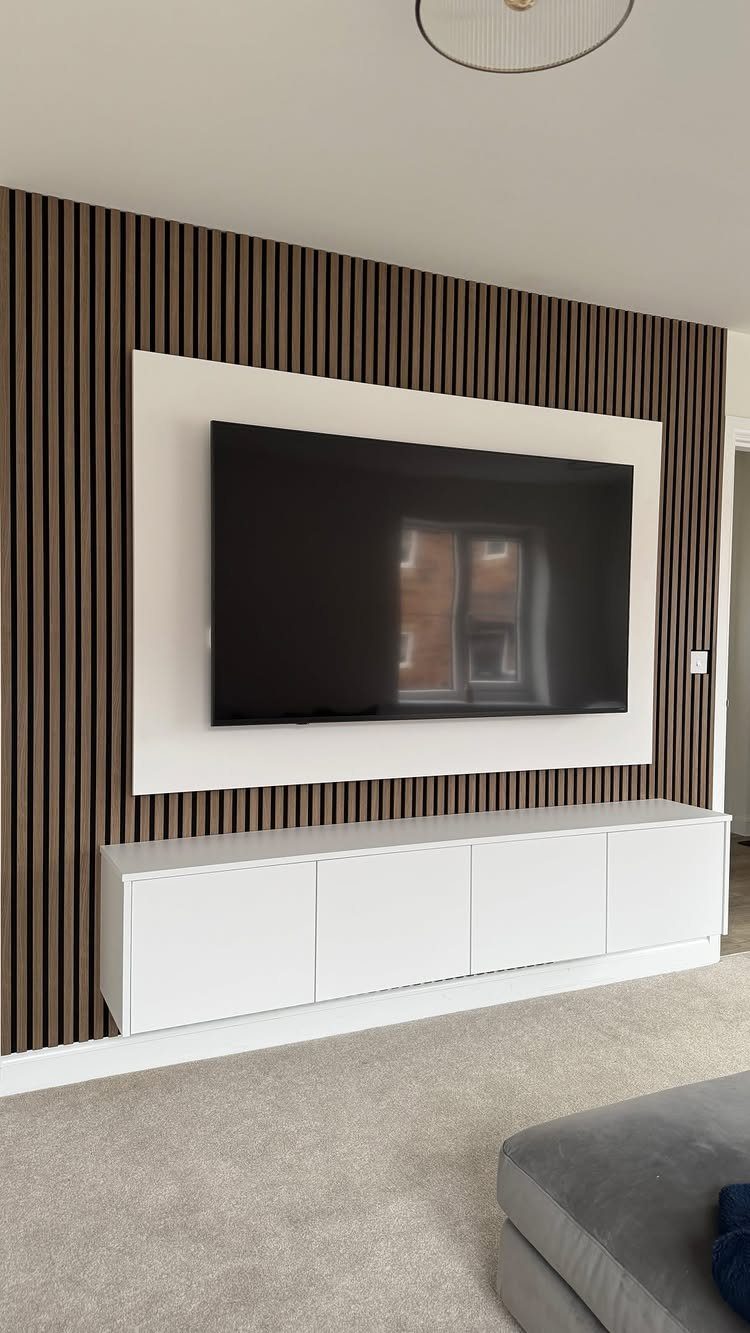
Dark walnut slats behind a white backer panel give the highest contrast of any pairing in this list.
The white panel functions as a mounting plate and a visual frame; the TV disappears into it more than it would against raw slats. On a tight budget, a stained oak reads similar from 10 feet away.
The panel dimensions that worked for one install: 2400mm tall by 600mm wide, 23mm thick, each covering 1.44m². Cut height to fit from skirting to ceiling minus 10mm if you are adding LED strip at the top edge.
A circular saw and a steady table handle the cuts; test-fit before fastening, because slat panels do not forgive being off by half an inch. Two people to maneuver, always.
6 Pcs RGB Black led recessed lights for acoustic panel: The black acoustic panel LED Strip measures 0.394 * 0.394 in and is available in various lengths, including 16 in, 24 in, and 36 in. Each configuration accommodates six parallel led panel lights. The LED strip's input cable is 3 M/9.84 FT , allowing for more flexible wiring options. The black smart recessed lighting is particularly suitable for acoustic panels, slat wall panel, wooden acoustic panels, cabinet and shelf lighting

【Modular Design】 6 individual COB LED strips that can be used separately or combined. Perfect for display cabinets, wardrobe compartments, acoustic walls, and more. They provide uniform, soft, and glare‑free light.

Custom Fit for Wood Slat Wall & Acoustic Panel Recessed Lighting: Purpose-built for narrow grooves in wood slat walls, acoustic panels and LED wall panels, this silicone strip light delivers a seamless flush finish for clean wall panel light effects. Its low-profile design fits perfectly into recessed lighting channels, eliminating the unsightly protruding look of standard light strips.
10. Slat Wall Room Divider with TV
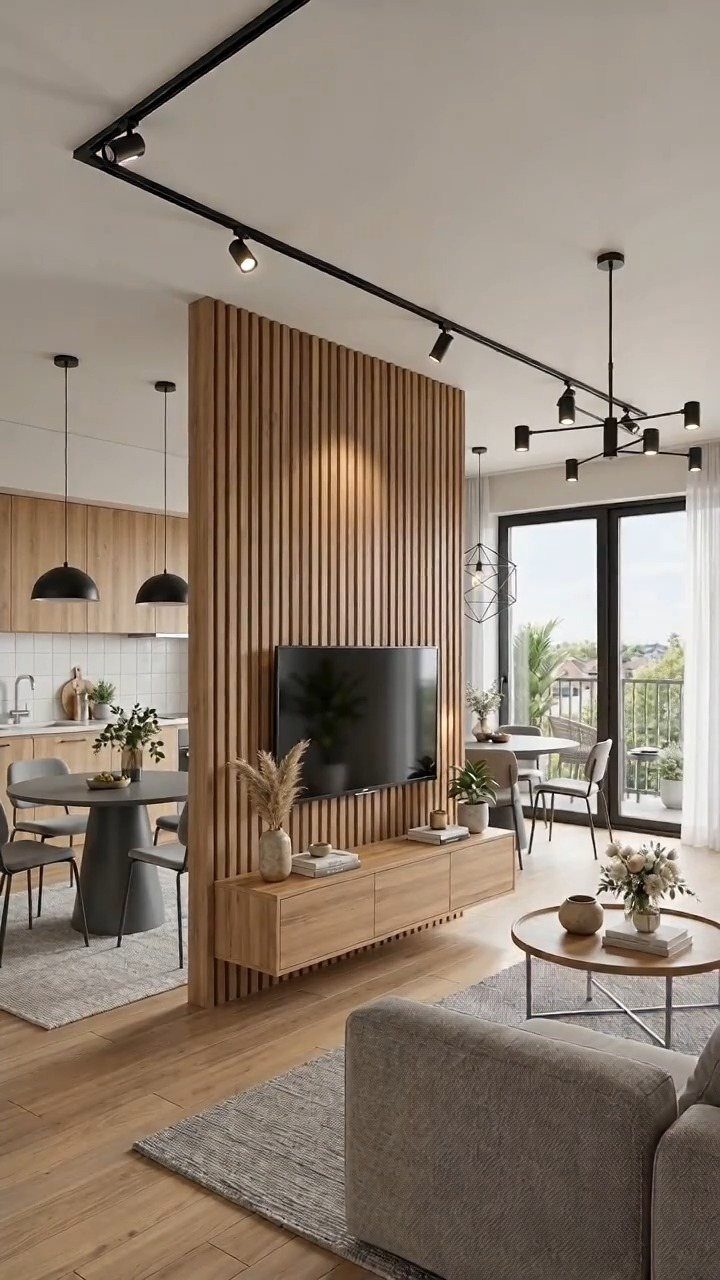
A slat wall that holds a TV and divides two rooms at once solves open-plan problems that curtains or furniture never quite fix.
The partition is freestanding, not built against existing structure, so the base needs anchoring to the floor joists or a heavy steel foot plate hidden inside the console.
The maker calls this three jobs at once: screen mount, media storage, and spatial boundary.
Running cables through a partition means planning the path before you stand the wall up. On the dining side, the slats read as texture without demanding a second TV.
For renters, this is probably too permanent; for a first home with an open living area, it defines the space without drywall and permits.

➤ REMOVABLE WALLPAPER: Easy to remove and reposition, no sticky residue left, it is absolutely renter friendly wallpaper. 𝗜𝗳 𝘆𝗼𝘂 𝘄𝗮𝗻𝘁 𝘁𝗼 𝗿𝗲𝗺𝗼𝘃𝗲, 𝗵𝗲𝗮𝘁 𝗶𝘁 𝘄𝗶𝘁𝗵 𝗮 𝗵𝗮𝗶𝗿 𝗱𝗿𝘆𝗲𝗿 𝘁𝗼 𝘀𝗼𝗳𝘁𝗲𝗻 𝘁𝗵𝗲 𝗮𝗱𝗵𝗲𝘀𝗶𝘃𝗲, 𝘁𝗵𝗲𝗻 𝗴𝗲𝗻𝘁𝗹𝘆 𝗽𝘂𝗹𝗹 𝗶𝘁 𝗼𝗳𝗳.

Superior Acoustic Performance — Welcome an unparalleled auditory experience with our sound proof panels for walls. Designed for superior noise-cancellation, these slat wall paneling redefine acoustic excellence. Our wood wall panels are tailored for a variety of settings, including homes, offices, and studios. Avana black oak wood slat wall panel creates an acoustically balanced environment, enhancing sound clarity. Experience functionality and style with our wood wall.

High Quality Materials: CIIHOO Acoustic Panels Crafted with natural wood textured paired with solid eco MDF core. According to SGS testing, the NRC value is as high as 0.8. These sound-absorbing wall panels can absorb reflected sound, effectively reducing echo and residual reverberation
Preparation Steps
Remove every fixture from the wall before the panels go up. A clean, level surface is the difference between panels that sit flat and panels that telegraph every bump underneath.
Cut panels to height with a fine-toothed hand saw. Where the slat ends show, slice the felt backing back with a sharp blade so the edge stays tidy.
Resizing on the wall is harder than resizing on a work table; test the fit before you commit adhesive or screws.
Measuring for Panels
For a typical TV wall, 3 panels is the starting order. Add 10% extra for cuts at boundaries and mistakes; the leftover panel you wish you had is always the one you skipped.
Two people to lift and hold; these panels run heavy and awkward, and a solo maneuver risks the wall, the panel, or your back.
Mark socket locations on the back before cutting. I measure from the baseboard up and from the right wall across, then I do it again.
A multi-tool handles the outlet cutouts.
Acoustic Properties
Gray felt backing on these panels soaks up sound instead of throwing it back. Panels without it look identical and offer zero acoustic benefit.
Behind a TV, with receivers and soundbars and open space beyond, that felt is what stops the hard bounce.
The gray shows in the narrow gaps between slats. Under room light, that gray against natural oak or walnut reads as shadow and gives the wall its depth.
It is not a flaw; it is what separates a finished wall from a flat one. Stand back with a sample under your own light before you commit.
If the contrast works there, the full wall will too.
Design Considerations
The depth of the slats plays against wood, stone, velvet, or bouclé nearby. For contrast against the linear grain, vivid shades read louder than safe neutrals.
Brushed or burnished metal catches the light that drops between the slats.
In natural oak and walnut, the gray felt gap is visible by design.
In black oak, the gap nearly disappears and the wall reads as solid mass; balance it with pale floors or furniture so the room does not cave in on itself. If it flatters there, the full install will follow.
Frequently Asked Questions
Can you mount a TV on a slat wall?
Yes. Lag bolts driven into studs hold more weight than adhesive strips ever will, especially when the bracket and the slat line up over the same framing.
What is a cheap alternative to slat walls?
Painted plywood or stained oak reads similar from 10 feet away at a lower cost. On a tight budget, I’d skip walnut and the premium finishes; natural or smoked oak gives most of the same visual warmth.
The acoustic benefit is harder to replicate cheaply, so a plain plywood wall with a separate rug or curtains handles sound instead.
What can I put on the wall behind my TV?
Wood slat panels, acoustic panels, marble, or a painted solid panel all work.
The gaps between slats throw thin shadows that draw a border around the screen without shouting for attention, and the felt behind the strips catches the frequencies that blur speech into mush.
A white panel against dark slats gives the highest contrast and lets the TV disappear into the frame.
Is it a good idea to put acoustic panels behind TV?
Yes. Bare drywall reflects treble back at you; the result is the muddy haze that makes you reach for the remote to turn up voices you still can’t quite separate from the score.
Slat panels with acoustic felt backing absorb those frequencies, so dialogue sounds clearer during daily viewing.